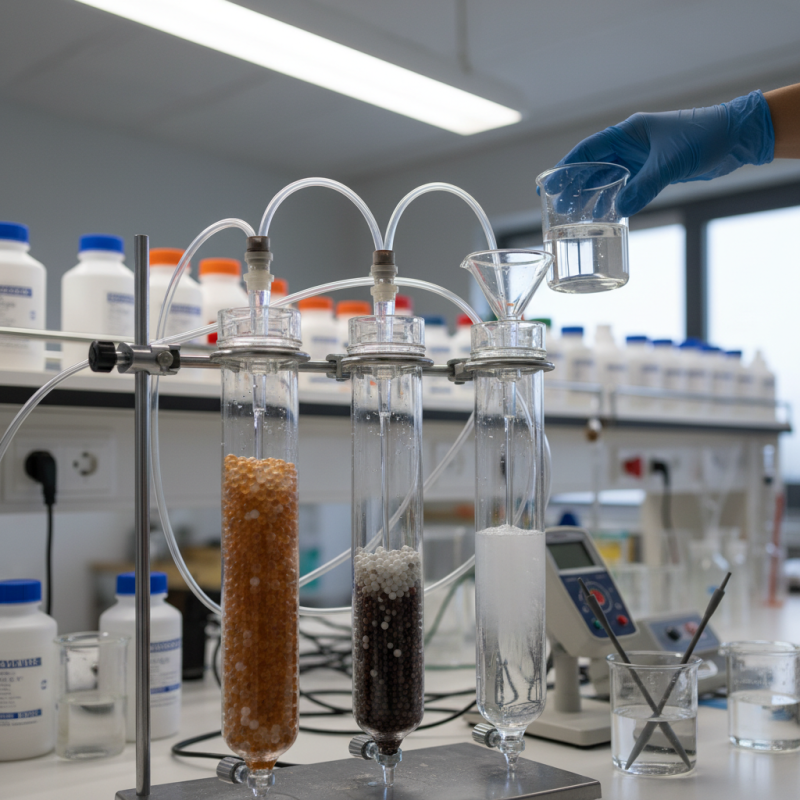
How to Choose the Best Strong Base Anion Resin for Water Treatment?
Choosing the right strong base anion resin for water treatment is crucial for effective purification. A strong base anion resin can remove various impurities from water. It plays a key role in ion exchange processes, enhancing water quality.
When selecting a resin, consider specific water conditions. Factors like pH levels, temperature, and contaminant types matter significantly. Each strong base anion resin has unique properties that impact performance. Testing and feedback from previous users can offer valuable insights. However, relying on generalizations can lead to poor choices.
Ultimately, choosing the best resin is not straightforward. It requires reflection and detailed research. Assessing long-term costs and maintenance needs is essential. Decisions should be based on both technical specifications and practical experiences. Only then can the benefits of a strong base anion resin be fully realized in water treatment.
Understanding Strong Base Anion Resins in Water Treatment
Strong base anion resins play a crucial role in water treatment. They are essential for removing unwanted ions like chloride and sulfate. These resins replace harmful ions with hydroxide ions, effectively improving water quality. Understanding their structure allows for better applications in various settings.
When choosing a strong base anion resin, consider its functional groups. Different resins have distinct properties. They can be quaternary ammonium or tertiary amine types, affecting their performance in specific situations. Not every resin suits every application. Testing and experimenting with small sample batches is necessary to determine the best fit.
Not all manufacturers provide complete information. Some resins may not perform as expected in certain water chemistries. Users often find discrepancies when scaling up from lab tests to real-world applications. This can lead to frustration and costly adjustments. Finding reliable data and matching the resin to your specific needs is critical. Continuous evaluation is key. The quest for the ideal resin often feels like trial and error.
Key Properties of Strong Base Anion Resins to Consider
When selecting a strong base anion resin for water treatment, certain key properties are essential. These resins are used to remove anions from water, making their effectiveness critical. Capacity is a primary feature to evaluate. Higher capacity resins can absorb more ions, leading to better water purity. Efficiency is also determined by the size of the beads. Smaller beads can enhance rates of ion exchange.
Consider the temperature tolerance of the resin. Some resins perform poorly in high temperatures. This can lead to degradation and reduced effectiveness over time. The pH stability is another factor. Some resins lose their functionality outside a specific pH range. Be sure to choose resins that fit your water conditions.
Tips: Prioritize resins with a low fouling tendency. This characteristic ensures longer service life and reduced maintenance costs. Ensure compatibility with the types of contaminants in your water. Sometimes, a resin appears perfect but fails in real-world conditions. Test your chosen resin in small batches first. This approach helps in avoiding costly mistakes.
Factors Influencing the Selection of Anion Resins
When selecting a strong base anion resin for water treatment, several factors come into play. The specific contaminants in the water greatly influence the choice. For instance, if you are dealing with high levels of nitrates, certain resins will perform better. Likewise, the pH level of the water affects the resin's efficiency. Resins may behave differently in acidic versus alkaline environments.
Another important consideration is the resin's physical structure. A resin with a larger bead size may provide quicker flow rates but could have lower exchange capacity. This is a trade-off. You might find that a smaller bead size improves ion exchange but can lead to channeling in the bed. Understanding the balance between flow and efficiency is crucial.
Cost also plays a vital role. Some resins can be significantly more expensive without offering substantial benefits. Evaluating long-term performance versus initial cost can be a challenge. Sometimes, cheaper options may lead to more frequent replacement. It’s essential to weigh these factors carefully. Making decisions without clear data can lead to unsatisfactory results.
Applications of Strong Base Anion Resins in Various Water Treatment Systems
Strong base anion resins play a crucial role in various water treatment systems. They are effective in removing anions from water, such as nitrates and sulfates. They excel in applications where high purity water is essential, such as in pharmaceutical manufacturing and power plants. These resins also help in the deionization of water. In drinking water treatment, they effectively eliminate contaminants. This ensures safer drinking water for communities.
Different systems utilize strong base anion resins in distinct ways. In industrial applications, they handle large volumes of water. Their ability to regenerate allows for long-term use, but not without challenges. Sometimes, improper regeneration can lead to resin fouling, which reduces efficiency. Home water systems often use these resins for point-of-use treatment. They help address specific local contamination issues.
Despite their benefits, there are limitations. Not all contaminants are effectively removed, leading to potential oversight. Regular monitoring and maintenance are required to optimize their performance. Users must be aware of the resin's lifespan. Neglecting these factors can lead to unexpected results in water quality. Understanding the application context is crucial for selecting the right resin.
Maintenance and Optimization of Anion Resin Performance
Maintaining anion resin performance is crucial for effective water treatment. Regular monitoring is essential. Check for resin fouling regularly. This can happen from organics, oils, and other contaminants. Quick identification helps in timely cleaning.
Optimization is also key. Adjust flow rates based on water quality. Improper flow can cause channeling. This reduces contact time. You might notice reduced efficiency as a result. Conduct periodic backwashing to dislodge trapped particles. This keeps the resin bed uniform for better performance.
Resin life can be impacted by pH levels. Verify the pH regularly. Extreme pH conditions can shorten resin lifespan. Implement a maintenance schedule. This ensures consistent operation. Plan for replacements based on performance trends. It’s an ongoing process that requires attention to detail.
How to Choose the Best Strong Base Anion Resin for Water Treatment?
| Resin Type | Application | Capacity (meq/g) | Operating Temperature (°C) | pH Range | Regeneration Method |
| Type I | Raw Water Treatment | 1.2 | 5-60 | 1-14 | Sodium Hydroxide |
| Type II | Industrial Wastewater | 1.5 | 5-70 | 1-14 | Sodium Chloride |
| Specialty Resin | Deionization | 1.8 | 0-50 | 1-12 | Mixed Bed Regeneration |
| Standard Grade | Drinking Water Purification | 1.0 | 5-55 | 3-10 | Sodium Bicarbonate |